Simplifying Shading eQUEST and TRACE 700

While eQuest and TRACE 700 have excellent shading algorithms (basically the same algorithm in both software pacakges), the complex input of some shading devices is intimidating to new users of the program, and often overwhelming for experienced users. I would like to propose a method to simplify shading for most applications to that of a simple overhang.
Consider this overhang:
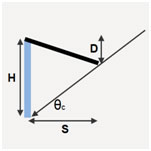
Let’s say for now, that is possible to simplify nearly any fixed shading application to such an overhang.
There are only two sets of conditions we need to consider:
- The percent of the area shaded when the sun is at the horizon (Θ = 0 degrees)
- The incident angle of the sun (Θc) where the window is completely eclipsed by the shading device. Let’s call this the “critical angle” or Θc
For illustrative purposes, let’s say we have a trellis with a 2” x 12” boards spaced 12” apart as shown here:
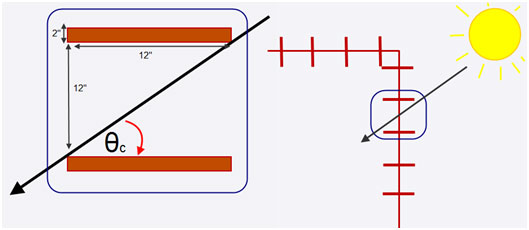
The critical angle is determined by:
Θc = tan (12/12)
We also need to determine the percent coverage at horizontal or Θ = 0 degrees;
% coverage =2/(2+12)*100%
Knowing these two numbers we can determine the overhang paramaters.
The overlay is determined by:
% coverage * H (ft) *-1 = D
The protruding distance from the window is determined by
tan [(H – D)/S] = Θc
Or
S = (H-D)/(arctan Θc)
= “Shade depth” (in eQuest DD wizard screen 7 when editing the Bldg shell)
While we are only working in two dimensions, the width properties could be kept the same. Assuming infinite end effects, it would of course make no difference. In general, this approximation works very well. Of course, it is not exact, but the differences are easily within the deviations of normal solar data, and therefore most shading types can be simplified based on two conditions: the horizontal condition and the critical angle.
Once these parameters are known, the final input would be to edit the overhang angle in the Detailed edit mode.
Bob Fassbender is the founder of Energy-Models.com and Fassbender Energy Advisory. A former Trane software engineer and instructor, Bob has more than 20 years of experience in energy modeling, building performance, utility incentives, and energy strategy. His work spans whole-building energy modeling, calibration, independent technical review, decarbonization planning, utility incentive strategy, renewable energy analysis, and owner advisory services. Bob has supported projects ranging from commercial buildings and utility programs to large-scale data center developments involving power infrastructure, geothermal systems, heat recovery, and long-term energy planning. Through Energy-Models.com, Bob has trained thousands of energy professionals in eQUEST, OpenStudio, EnergyPlus, LEED modeling, and building performance analysis. He continues to advise owners, engineers, architects, and developers on energy-related decisions while exploring emerging technologies such as artificial intelligence, machine learning, and advanced building analytics.